

Solar Panel Payback Period Explained: What to Realistically Expect

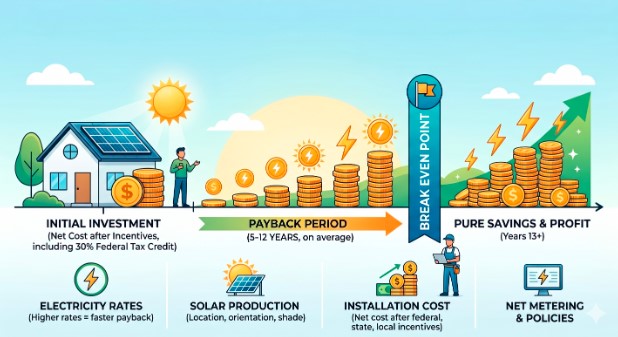
The payback period is the single number most homeowners want to know before buying solar. How long before this pays for itself?
The honest answer is: it depends on several factors that vary significantly from one household to the next. But the variables are knowable, the math is straightforward, and you can calculate a realistic estimate for your own situation before you talk to a single supplier.
Here is how to think about it correctly.
What the Payback Period Actually Measures
The payback period is the time it takes for the financial benefits of a solar system to equal the initial cost of buying and installing it.
After the payback period, every kilowatt-hour your system produces is effectively free electricity. For a system with a 25-year performance warranty and a 6-year payback period, that means roughly 19 years of near-free electricity production.
The payback period is not the same as return on investment. A system with a 6-year payback on a 25-year lifespan has a very strong ROI. A system with a 12-year payback on the same lifespan still delivers positive returns, just with a longer wait for them.
The Key Variables That Determine Your Payback Period
Six factors drive the calculation. Change any one of them significantly and your payback period shifts.
- System cost — the upfront price of panels, inverter, mounting, installation, and connection. In Romania, a complete 6 kW residential system currently costs between 4,500 and 7,500 EUR depending on component quality and installer. A 10 kW system runs 7,000 to 12,000 EUR.
- Annual production — how much electricity your system generates per year, expressed in kilowatt-hours. This depends on system size, panel efficiency, roof orientation, shading, and local solar irradiation. A 6 kW system in southern Romania produces approximately 7,200 to 8,400 kWh per year. The same system in northern Romania produces 15 to 20% less.
- Self-consumption rate — what percentage of your solar production you use directly versus export to the grid. Higher self-consumption means more electricity bill savings and a faster payback. Most households without battery storage self-consume 30% to 50% of production.
- Electricity tariff — what you pay per kWh from the grid. Higher electricity prices mean more savings per kWh of solar production, which shortens payback. Romanian residential electricity prices have risen significantly since 2021, which has improved the economics of solar for all households.
- Prosumer feed-in compensation — what you receive for electricity exported to the grid. Romanian prosumer regulations allow households to offset exports against imports over a billing period, which effectively means you receive the full retail tariff rate for exported electricity rather than a lower wholesale rate.
- Subsidies and grants — Romania's Casa Verde Fotovoltaice programme has historically offered grants of up to 20,000 lei for residential solar installations. Availability has fluctuated, but accessing a grant dramatically shortens the payback period for qualifying households.
Running a Realistic Calculation
Here is a worked example for a Romanian household:
- System: 8 kW, cost 7,500 EUR including installation
- Annual production: 9,200 kWh (moderate sun region, good south-facing roof)
- Self-consumption: 40% of production = 3,680 kWh used directly
- Export: 60% of production = 5,520 kWh exported and offset against grid consumption
- Electricity tariff: 0.85 lei/kWh (approximate residential rate)
- Annual electricity bill saving: 9,200 kWh × 0.85 lei = 7,820 lei per year
- System cost in lei at 5.0 exchange rate: 37,500 lei
- Payback period: 37,500 ÷ 7,820 = 4.8 years
That is under five years on a system warranted for 25 years. The remaining 20 years of production represents roughly 184,000 lei in electricity at today's prices — before accounting for electricity price increases over that period.
If the same household received a Casa Verde grant of 20,000 lei, the net system cost drops to 17,500 lei and the payback period shrinks to 2.2 years.
Why Self-Consumption Rate Matters So Much
The single biggest lever most homeowners can pull to improve payback is increasing self-consumption — using more of what they produce rather than exporting it.
Under Romania's prosumer system, exported electricity is offset against future imports at the retail rate. So exporting is not wasteful. But there is a timing mismatch: you export in the middle of the day when production peaks, and import in the evening when consumption peaks. If the offset rates are equivalent, it doesn't matter economically. But if tariffs change — and energy policy does change — households with higher self-consumption are less exposed.
Practical ways to increase self-consumption:
- Run high-consumption appliances during peak production hours — dishwasher, washing machine, tumble dryer, oven — timed to run at midday rather than morning or evening
- Charge an electric vehicle during the day if you have one — a single charge session can consume 10 to 30 kWh of solar production that would otherwise be exported
- Add battery storage — a 5 to 10 kWh battery can shift self-consumption from 35% to 70% or more, capturing afternoon production for evening use
- Install a heat pump water heater — heating water with solar electricity is highly efficient and absorbs significant daytime production in a household that would otherwise export it
How Electricity Price Increases Affect Your ROI
Solar payback calculations are usually done at today's electricity price. But electricity prices are not static.
Romanian residential electricity prices have increased substantially over the past five years and are structurally linked to European energy market prices, which will remain volatile. Every time the grid electricity price rises, the value of each kilowatt-hour your solar system produces rises with it.
A system with a 6-year payback at today's prices might effectively have a 4-year payback if electricity prices rise 20% over the next two years — which is well within the range of historical price movements in Romanian energy markets.
This asymmetry is one of the strongest arguments for solar as a long-term financial decision. You lock in a significant portion of your electricity cost at today's prices for the next 25 years. Grid electricity costs remain variable and exposed to fuel prices, carbon costs, transmission infrastructure charges, and energy policy changes that are entirely outside your control.
Component Quality and Its Effect on LongTerm Returns
A cheaper system that degrades faster or requires inverter replacement at year 10 changes the payback calculation significantly.
Tier-one solar panels carry linear performance warranties guaranteeing at least 80% of rated output at year 25. Cheaper panels may carry the same paper warranty but degrade faster in practice, producing less energy over the system's life.
When comparing panouri fotovoltaice options and full system packages, prioritize suppliers who can demonstrate the warranty claim process for the specific brands they sell. A 25-year performance warranty from a manufacturer with no European service presence is worth much less than the same warranty from a brand with an established regional support network.
Inverter replacement is the most predictable maintenance cost in a solar system. Budget for one inverter replacement over a 25-year period. A quality hybrid inverter with a 10-year warranty and a known regional service network is worth the extra upfront cost compared to a budget unit that will be difficult to replace or repair in year 8.
What a Realistic Expectation Looks Like
For a well-designed residential system in Romania, using quality components, installed by a competent ANRE-certified team, without a subsidy:
- Payback period: 5 to 8 years
- System lifetime: 25 to 30 years
- Years of net positive return: 17 to 25 years
- Total electricity savings over system life: 3x to 5x the initial investment at stable electricity prices
With a Casa Verde grant, those numbers improve materially. With electricity price increases over the system's life, they improve further.
The payback period is the starting line, not the finish line. What happens after payback is where the real financial case for solar is made. A system that pays back in 6 years and runs reliably for 25 is one of the better long-term investments available to a Romanian homeowner today.